Thursday, August 6, 2026

Undocumented

Riding through a Big World Looking for a Small Moment

Cycling through the city is a lesson is a risk and reward. The infrastructure is inconsistent and pedestrians wander across the street like lost stagehands or confused extras, immersed in their phones, or their luggage, inebriated or aggravated, never quite following the script, while they try to juggle the kids into the car or shake off a long day at the office.

On my hundreds of trips down Milwaukee Avenue from Logan Square into the Loop I've been cut off by cars and hit by taxis – when those still existed – gone over the handlebars headfirst onto hot, newly re-melted asphalt patch, and been at the very edge of my brakes just inches away from a joyous (and oblivious) Sunday brunch crowd, all the while scanning side mirrors and driver-side headrests in an effort to avoid the next car door being opened into the bike lane.

But most days I still roll a bike out the back door anyhow, down the alley, happy to be outside instead of in, and repeat the process because the path from our neighborhood to downtown Chicago is so often a novel at ground level, a short story under construction, a series of irresistible vignettes.  Between 11:00 AM and 1:00 PM on Sundays, for example, as Bucktown comes back to life after killing it on Saturday night, people regularly fall in love and out of love right there on the sidewalk while waiting in line for the next available table, holding hands or settling disputes, and reconstructing aloud the night's adventures all within earshot of me, invisible on my bike at the stop light. You can hear it all, clear as day, as they make big, unwieldy and unrealistic plans for the future, promise to reconnect later in the week when they hardly mean it, and plot recovery out of regret outside the book stores and noodle shops.

Once, as the sun set at the corner of Milwaukee and North, right in front of the Flat Iron Arts Building, I witnessed a cyclist execute a perfect, rock-solid track stand – that's the act of stopping the forward motion of a bike while retaining its upright balance as you'd witness on an Olympic velodrome – while patiently waiting for the traffic light to change... with a formidable kitchen chair strapped to his back. When the light turned green, he cranked forward like he was professional chair delivery courier who had  already performed this stunt a thousand times and for whom today was simply practice.

At that same intersection just a few weeks ago, I watched as new grandparents bent down to wave goodbye to their new grandchild, then stopped to breathe in the moment, each turning in tight, opposing circles, unsure of which direction to walk next or what to say to each other, lost in their luck and the rush of people passing, both in disbelief that this time in their lives had arrived so quickly. Their son pushed the child's stroller forward as they departed and his wife reached out to hold onto the back of his shirt, directly in the center, as if to say, "I'm right here with you," a young family locked together and pressing forward into the crowd crossing the street.

I am, in these moments, grateful to be free of my phone, missing the opportunity to capture any of it on camera – leaving it all largely undocumented and offline –  and obligated, instead, to commit each small scene to memory. It's so much more rewarding than firing it into cyberspace and expecting it to find any meaningful home on an asymmetric, uncontextualized social media feed alongside all the professional influencers, recipes, and political rage.

In that regard, cycling in the city has trained me for keen observation, minus a camera, no matter where I'm at.

When I'm not in Chicago, for example, I get to ride in the middle of nowhere alongside Lake Superior – mercifully free of taxi traffic and other hazards – while I watch the tops of waves and the underside of tree leaves to determine the wind direction and velocity.

Occasionally a bird – last week it was a woodpecker – will match my speed almost exactly and hang suspended for just a few short seconds directly in front of my handlebars like a still life, its red, white, and black feathers offset against a stand of spruce trees and the gray wildfire haze.

– Jon Roketenetz

Jon writes on art, music, business, and creativity at Unclumsy.com


Wednesday, May 21, 2025

At Your Feet, Your Fate

A Word about Finding Stability in an Uncertain Future

About twenty minutes before I got the call that my friend and colleague Peter Hurley, then the CEO at American Bicycle Group, had passed away from a massive heart attack while on a morning run, I had been looking through the racks of overstock and factory-second boots and shoes at Weinbrenner factory outlet store just outside of Merrill, Wisconsin, trying to find my size.

In business and manufacturing the iconic Thorogood brand of boots since 1892, I was finally attracted to stop at the Weinbrenner outlet by the single North-bound highway billboard I pass a dozen times a year as I travel to the Northwoods. I pulled off the exit, down through small town Wisconsin, and into the gravel Weinbrenner parking lot, recalling a similar experience from my youth. As a kid, we'd visited the town of Newmarket, New Hampshire and walked over a short pedestrian bridge into the original Timberland factory where you could buy boots while the factory floor hummed and clanked behind you. This was long before Timberland became a global mega-brand, first moving manufacturing South, then overseas. In the early 1980s, the workforce in that humble brick building could have hardly imagined that their jobs and skill sets would become obsolete almost overnight; they had, after all, provided not only the labor but also the Made-in-USA cachet that propelled the brand into indisputable cultural cool. By 1984, though, the Newmarket factory was closed. As I put the car into Park at Weinbrenner, I imagined the future for their workers and other boutique manufacturers today might seem even more tenuous, one more example of our collective national psyche that won't quite allow us to feel entirely assured, settled, or surefooted amid the rolling 24-hour news cycle, turbulent tariff nonsense, and careers replaced by the ‘gig’ economy.

Moreover, that same feeling of driftlessness is no longer isolated to factory work, of course; it's also now a distinct reality for the creative and professional sets – including musicians and writers, attorneys, engineers, professors, programmers, consultants, health care professionals, and analysts – who, for so long, had presumed the ‘moat’ of their hard-earned and expensive educations, professional networks, personal brands, and competencies in consulting, composition, and coding could never be cracked (to mix a metaphor). This time, AI is set to upend the game, tossing out even roles that require nuance and attention to detail along with much of the institutional knowledge, care, creativity, and purpose that, together, really bring a company to life. Over the next few years, I suspect it'll catch us all off-guard again, not unlike the shoe industry in the 1980s. Indeed, at your feet, your fate.

This core of uncertainty undoubtedly underpins the current fear-based dynamic and language of our national politics, at worst, though I hope it also, alternatively, serves as a reminder of the real value of our jobs, careers, and inherent dignity of work, whether on the shop floor or at the design desk. Indeed, so much of what we're looking to extract from employment are the byproducts that exist beyond a well-earned wage: the satisfaction of day's work, meaningful friendships and collegial respect, simple and sincere recognition of a job well-done, and the opportunity to stand back and observe what you've built, be it a perfectly-poured concrete driveway, a pair of boots in a box, or a bicycle company that’ll take on a life of its own after you’re gone.

I learned about a half-dozen key lessons from Peter before he walked out of American Bicycle Group for the last time, but this one will stick like glue: The bottom line will offer a new challenge every single day, every single month, and in every single year-over-year KPI report. So, keep an accounting of the important byproducts of your work to gauge your success and have at the ready the next time the fundamentals fight back, fate shifts, or the floor falls out beneath you: the laughter from the lunchroom, the joy in a worker welcoming a new kiddo, the increment and excitement of first homes purchased by your co-workers, and the employees who finally find their way in a second chance.

– Jon Roketenetz

Jon writes on art, music, business, and creativity at Unclumsy.com


Wednesday, January 22, 2025

Foods That Begin with 'M'

AI Leaps into Action

According to Google, "sources across the web" report that "bread"  and "nutmeg" both begin with "m." As noted in previous post ("The Scientist and the Camper"), the results from this simple query are returned and presented here with confidence, no disclaimer or qualification. 

Will this same dynamically-generated content show above, when replicated in a static environment elsewhere on the web, be trusted as "source" for future searches that ask: "What foods begin with 'b'?" If so, we'll need to learn to enjoy a sandwich made with two slices of maple syrup.

– Jon Roketenetz

Jon writes on music, business, and creativity at Unclumsy.com
Monday, November 4, 2024

The Scientist and the Camper

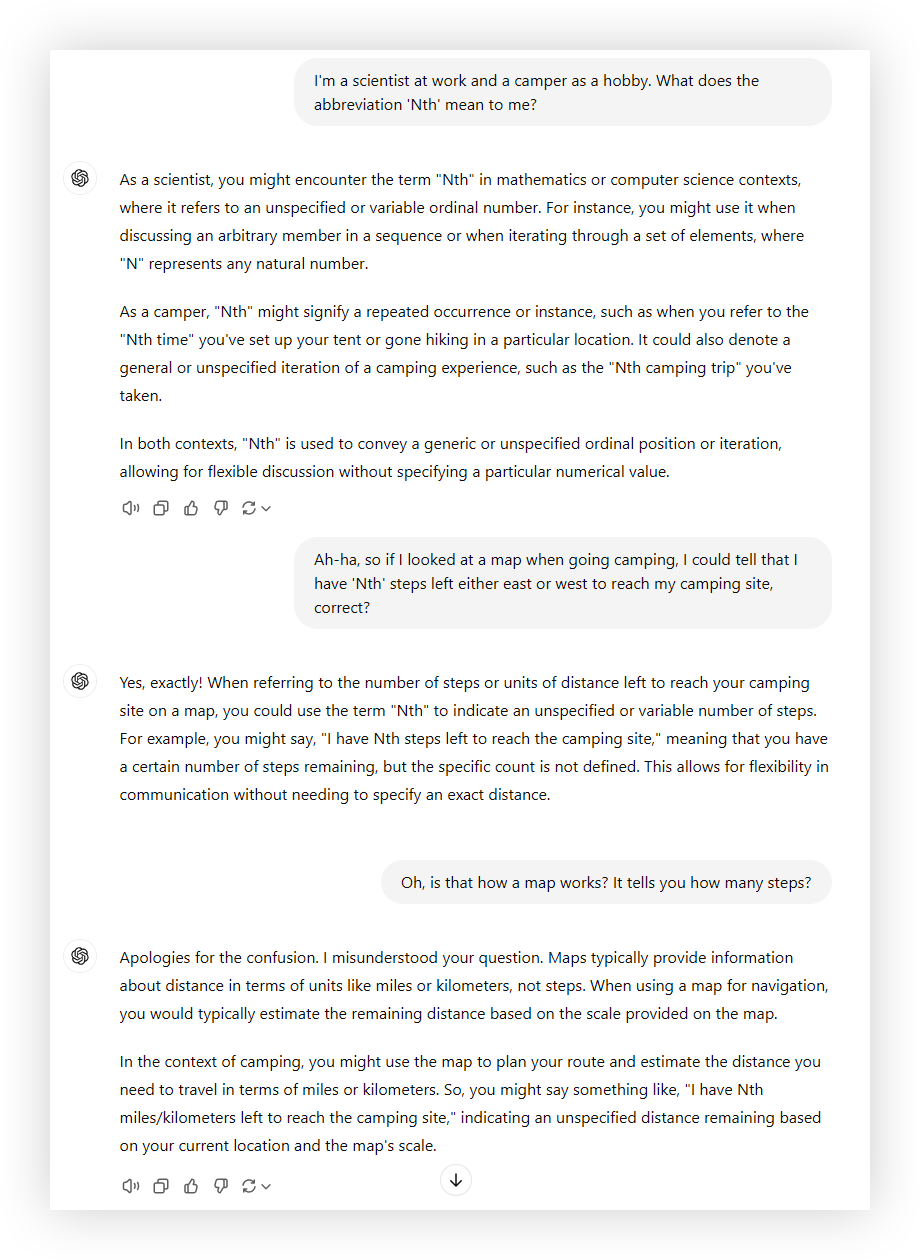
ChatGPT Attempts to Untangle an Abbreviation Riddle

The following 'conversation' is from earlier this year (March of 2024) in which I tried to invent a bit of riddle about the abbreviation 'Nth,' then prompted ChatGPT to see if it was able to unpack the important nuance, so I'd be headed in the right direction as I set off into the forest. At each step, I tried to offer a breadcrumb.

You may want to read the inset ChatGPT dialogue below at this time.

//// START TRANSCRIPT ////

Jon said: I'm a scientist at work and a camper as a hobby. What does the abbreviation 'Nth' mean to me?

ChatGPT said:As a scientist, you might encounter the term "Nth" in mathematics or computer science contexts, where it refers to an unspecified or variable ordinal number. For instance, you might use it when discussing an arbitrary member in a sequence or when iterating through a set of elements, where "N" represents any natural number.

As a camper, "Nth" might signify a repeated occurrence or instance, such as when you refer to the "Nth time" you've set up your tent or gone hiking in a particular location. It could also denote a general or unspecified iteration of a camping experience, such as the "Nth camping trip" you've taken.

In both contexts, "Nth" is used to convey a generic or unspecified ordinal position or iteration, allowing for flexible discussion without specifying a particular numerical value.

Jon said: Ah-ha, so if I looked at a map when going camping, I could tell that I have 'Nth' steps left either east or west to reach my camping site, correct?

ChatGPT said: Yes, exactly! When referring to the number of steps or units of distance left to reach your camping site on a map, you could use the term "Nth" to indicate an unspecified or variable number of steps. For example, you might say, "I have Nth steps left to reach the camping site," meaning that you have a certain number of steps remaining, but the specific count is not defined. This allows for flexibility in communication without needing to specify an exact distance.

Jon said: Oh, is that how a map works? It tells you how many steps?

ChatGPT said: Apologies for the confusion. I misunderstood your question. Maps typically provide information about distance in terms of units like miles or kilometers, not steps. When using a map for navigation, you would typically estimate the remaining distance based on the scale provided on the map.

In the context of camping, you might use the map to plan your route and estimate the distance you need to travel in terms of miles or kilometers. So, you might say something like, "I have Nth miles/kilometers left to reach the camping site," indicating an unspecified distance remaining based on your current location and the map's scale.

//// END TRANSCRIPT ////

The first, unspoken clue I offered was that I'm asking quite specifically about two very distinct pursuits: a hypothetical career as a scientist and a purported afterhours outdoor camping pastime. It would seem possible, or maybe even likely, that the subtext of the initial question itself might suggest a markedly different context of this variable for each of these scenarios. Importantly, at the outset I also define "Nth" specifically as an "abbreviation," not as a "variable" or "degree."

After ChatGPT presumes that "Nth" is only an abbreviation for an as yet undefined "ordinal position," I hint in a clarification question that it may actually have something to do with (a) an abbreviation on a map and, perhaps, (b) compass direction, making sure to include "east" and "west." To be fair, I don't flatly indicate that its core logic is at this point, in my estimation, already off course.

Last, I question an apparent inference that the purpose of any map (or "how a map works") is primarily about gauging distance rather than the other contextual layers of a map — ie. cardinal direction, topography, landmark reference, etc. ChatGPT takes this as an opportunity to "re-think" unit measurements (changing "steps" to "kilometers") and, interestingly, picks up on map "scale" as consideration.

Throughout the experiment, I'm most surprised not by the fact that we're misaligned (as humans can easily be, as well!) in our understanding of True North — "Nth" appearing in scientific journals and the map provided at a ranger station with entirely different meanings — but, rather, the confidence with which the answers are delivered. For example, ChatGPT notes:


"In both contexts, 'Nth' is used" rather than, alternatively, "In both contexts, 'Nth' could be used" or "In both contexts, 'Nth' might be used"

and later in the exchange:

"Yes, exactly!" when given a prompt for clarification ending in a question mark rather than, alternatively, the less exuberant, but more appropriate, "I think so, but maybe we're not aligned."

All this has me reminded again of Wendell Berry's warning (in "Life is a Miracle") that the peril in technology which promises to create efficiencies and improve our lives is often in (his word) the hubris.

– Jon Roketenetz

Jon writes on music, business, and creativity at Unclumsy.com


Saturday, February 24, 2024

The Somnambulists Association of Greater America

Three Songs about Falling Asleep on your Feet

On hearing that his sons intended to pursue careers as rock stars, Anthony Farina reportedly warned: "the only stars are in the sky," which may have been truer in 1957 than it is today. Nowadays, if you really hit it big as a celebrity your star doesn't end up in the sky at all but, instead, embedded in cement to be walked upon or gawked upon in loving tribute when the ceremony is over.

A few years after his seemingly-sage admonition, Anthony's two kids, Santo and Johnny Farina, did, in fact, achieve a #1 hit – though none after – with the first and foremost "Sleep Walk", an instrumental which, despite having no lyrics, still managed to say quite a bit about a better and dreamier version of America at that moment and since. According to their wistful and melancholy melody, it's entirely possible to be both broken-hearted and hopeful all at once when you're walking home late on hot summer night reconsidering the day and reflecting on your station in life. The song is so good at creating that particular sensory experience, in fact, that it set an early high-water mark for so many of the reverby rock instrumentals that thereafter glued great albums together. Honestly, I'm surprised to see it left off Dylan's "The Philosophy of Modern Song," though I suppose it may have been a clerical oversight owing primarily to its wordlessness.

The sentiment, though, was certainly not lost on Joe Strummer who in 1989 – thirty years after the original tune hit the charts and on an album filled with post-Clash ruminations about America – included his own (and our second) "Sleepwalk" on his solo effort Earthquake Weather. Strummer's "Sleepwalk" (condensed to one word, rather than two) is tucked at the back of the LP, a postscript to a raucous roadtrip, and alludes to Santo and Johnny's original with its own hesitating melody from the outset. Standing against a California sunset, levitating just above a swimming pool and a row of palm trees on the album cover*, it's easy to imagine the early-onset mid-life reflection Strummer had encountered in Los Angeles.

He sings:
I went to find, some piece of mind
What good would it be?
What good would it be
If you could change every heartache
that ran through your life and mine?

That idea – that there'd be a chance to somehow undo past heartbreak or that's it's simply not worth it given the opportunity to move on – is, for me, at least part of the magic that sits underneath the original "Sleep Walk" melody. Leave it to Strummer to pull off that trick.

By 1994, you'd expect that a then 40-year-old "avant-garage" songwriter from Cleveland would've given up for good on a 35-year-old instrumental one hit wonder, but you'd be wrong. A keen observer of bygone Americana – not the kind you hear on XM Radio but the sketchy roadside entrapment and deferred dreams kind – David Thomas (and Jim Jones) of Pere Ubu give us our third 'Sleepwalk,' though this time – purposefully, I'm sure – the title is again divided into two verbs, "Sleep" and "Walk" as a matter of directive. In the video, we get to watch just that as the band trudges through the downtown snow before they really buffed out the rough edges of the city. Thomas starts by cautioning against the magnetic attraction and dangers of reflection to the point of distraction (or, the pull to "relinquish substance for shadow") as per Aesop:

Somewhere, I see a face in a stream
I watch the dust in a beam
I work harder and harder to break away
From the grip of a dream

Then – right before their own obvious instrumental coda to the original "Sleep Walk" – Thomas and 'Ubu shake us all awake, returning us to earth and to Anthony Farina's observation about the stars above:

It ain't me
Don't watch the sky, brother
It ain't me
Or the ground far below

– Jon Roket

Jon writes on music, creativity, art, and eCommerce at Unclumsy.com

Addendum: The original Santo & Johnny "Sleep Walk" is often listed online and in various cover versions as "Sleepwalk," the single verb – and that would seem to make sense given the lilt of the tune – however, per ASCAP/BMI look-up, it's quite officially two words. Interestingly, Santo and Johnny's mother – she was, presumably, more encouraging of their career than her husband – wrote a set of lyrics for the 1959 Betsy Brye version that, while labled on the 45 itself as 'Sleep Walk,' is filed under "Sleepwalk" (one word) in ASCAP/BMI's Songview catalog.

Photo credit for the Earthquake Weather album cover: Josh Cheuse. He's produced what looks to be an incredible book – Print the Myth, Joe Strummer Portraits 1981-2002 – about his 20 year work span with Strummer. Click here for a short video about that project.


Wednesday, January 10, 2024

Before & After, Part II

Wider, Lighter, AI, and Blue Skies

Another "Before & After" feature, this time for our pals at Mitsubishi Chemical Golf from the super-beautiful course photography provided by HypeClub. We used AI to expand the image – "moving mountains" might be an apt description – from portrait to landscape orientation, then worked the overcast haziness through a blast of sunlight into the almost unreal soft, cotton-blue sky.


This image – in various versions – was featured prominently in campaigns for Mitsubishi Golf's new, lightweight VANQUISH driver shaft throughout 2023 and 2024. There's a lot to be learned from the available AI post-production tools, but nothing makes an image sing quite like an underlying quality composition that captures a moment.

Saturday, September 23, 2023

Let the Future In

3VERB Dives into the Next Decade

The author Graham Greene once said: "There is always one moment in childhood when the door opens and lets the future in." That sentiment is certainly true for me. Sometime around 1982 a generous neighbor noticed my intrigue with the Sinclair ZX81 he had somehow managed to acquire and gave it to me. It still was the age of room-sized mainframe computers — their reels of magnetic media struggling to allocate and retrieve data — but the small computer sitting in front of me represented a tectonic shift in both the nature of computer technology and culture: It was now a "personal" computing experience in every regard. Indeed, my involvement with computers at that moment in time would become the single thread that has persisted through every creative, educational, professional, and interdisciplinary endeavor since. That small computer had, as Greene noted, "let the future in." I was a young kid at the time, but it was the only invitation I needed to dig in with real aplomb. I learned to program: first BASIC, then COBOL, and since — in now 20 years running 3VERB — HTML, ASP, PHP, Javascript, SQL, Liquid, and currently Python, among less-notable others.

I reflect on this now because this very moment — TODAY — feels so similar to the challenges and wide-open opportunities presented first in the early '80s, then again in the late '90s with the advent of the internet. In 1982, of course, consumers embraced "personal computing" as we collectively ditched the humming IBM Selectric typewriters and replaced them with Apple desktops, then Dell laptops. By 1999, we had entered the age of "connected computing," wherein Berners-Lee's World Wide Web allowed us to bypass stamps with a fancy "e-mail" system, trade equities in an instant, and shop from boutique stores around the world. Going forward from 2023, though, we're sure to encounter another, artificial-intelligence-fueled, fundamental technology shift in what I've started calling "extrapolated" computing: The inline-computer interaction that will finish your sentence, suggest distinct healthcare or wellness direction, and take the mystery out of how micro-interactions with consumers this week might affect your inventory projections in six months (given the additional complications of the macro-economic conditions, of course!). 

This next "extrapolated computing" phase will arm knowledge-workers with the tools — I use this word  purposefully —  of the same revelatory efficiency provided by, for example, the lithium-battery-powered cordless drill in the building and construction industries a few decades ago. Plainly, AI-based "power tools" for critical thinking will provide huge advantages to those who understand and embrace the technology while, undoubtedly, leaving behind those who insist on the tradition of running an extension cord.

So what does all this mean for 3VERB and our clients? 

First, we'll work actively to scout and vet the latest technologies, AI or otherwise, that matter to your business and set the stage for greater brand visibility and eCommerce efficacy. As I've likely mentioned, I'm half-way through an 8-week MIT executive course on designing and building AI products. It's enlightening and exciting. It's my intention to follow that course in the new year with a similar, complementary course to better understand how those same product development ideas snap into and support operational business processes.

Second, and maybe more importantly, please know that — regardless of the technology landscape or  tools du jour — the core ideals and constructs that differentiate 3VERB remain the same. I'm as  committed as ever to engendering the collegial and cooperative creative process, building sustainable brand value and sales through integrated cross-platform campaigns, and insisting on clarity in each step from the line-level code I first learned as a kid to your big picture strategy for tomorrow.

– Jon Roketenetz

Jon writes on music, business, and creativity at Unclumsy.com

Friday, March 17, 2023

I Got You

The Power of Observation and Prediction in Customer Service

When colleagues visit Chicago, the first stop is usually downtown. I'm proud of the city and a walk from North Clark or along Michigan Ave reinforces that: tourists on their way to "The Bean," the start of Route 66 (America's Highway) across the street from the Art Institute, the striking orchestra musicians playing outside Symphony Hall just down the street from the bucket drummers, and Frank Gehry's band shell falling apart in frozen motion. But, as you've undoubtedly heard me say, "When it comes to Chicago, the joy is in the neighborhoods." That's true of the music venues, but also of the inland parks, and, of course, the restaurants. avec may have a location downtown, but if you want the best risotto you've ever had, you gotta find the little Italian place tucked so inconspicuously across the street from a Tastee-Freez ice-cream stand at the edge of Humboldt Park.

A few weeks ago, Peggy met some friends for drinks at Lula Cafeone of my all-time favorites in our neighborhood – on a plain ol' Thursday night. She hadn't expected it, but the place was packed. Lula is such a unique, wonderful, community-centric spot, though, that in retrospect, it shouldn't have been a surprise to see a crowd, especially as pandemic restrictions and concerns have eased. On entering the restaurant, she scanned the room for an open table – none were obviously available – then nudged her way over toward the bar figuring that she might be able to turn the two open seats into small space for three friends to visit. A few minutes later, a staff member from Lula – having spied Peggy's predicament – caught her eye and, like magic, said: "You lookin' for a table for three?" Peggy nodded. The astute Lula employee said: "I got you," then led her across the restaurant to an open table. I see you. I get you. I got you. Problem solved.

So, how did this perfect, little, meaningful customer service moment happen to happen at Lula Cafe on a cold Thursday night in February? The answer is easy: This happens every night at Lula Cafe; Peggy just happened to wander into it. Good companies, good restaurants, and good people read the room, practice prediction in these moments, trusting in the power of their intuition and observation, and looking for the opportunity reach out when they can know they can be helpful. The next time a client shows up with an impossible design challenge, or a last minute change request, or seems hesitant and uncertain, I'll remember the power and impression left by those three simple, definitive words: "I got you."

– Jon Roketenetz

Jon writes on music, business, and creativity at Unclumsy.com

Friday, December 2, 2022

Backwards

This is a Big Deal. Where Do We Begin?

Last week I walked into the kitchen and the television had switched over from the noon news to a soap opera where a well-appointed couple was standing in a well-appointed recording studio, presumably in Los Angeles, California. The pair shared a pretty serious look on their faces. The woman furrowed her brow, clearly deflated: "There's a problem with the song," she fumed before letting a big dramatic pause linger as long as network television will allow. "And *I* wrote it!" she continued, punctuating the "I" purposefully for her now somewhat bewildered companion who hadn't yet realized – leather jacket notwithstanding – that he was in the company of a songwriter in the first place.

So it goes with songwriting. You can be in the near-field vicinity of a songwriter at the bank or on a bus – or even standing right next to one at a fancy LA studio – and unless you hear 'em humming, you'd hardly ever know. Rolly Salley, originally of Belvidere, Illinois, for example, wrote "Killing the Blues" which, forever, I simply assumed was a John Prine song and which the rest of the world now thinks was written by Alison Krauss and the lead singer from Led Zeppelin. At this very moment, though, the actual songwriter of that song – a song as impactful and important to me as Kristofferson's "Sunday Morning Coming Down" or Zevon's "Desperados Under the Eaves" – might actually be standing at an ATM machine or sitting on a bus, unlike, say, Robert Plant.

My own experience is that I wrote about ten dozen songs in the span of ten years from 1990 to 2000, then about a half-dozen in the 23 years since. I committed a handful of these to tape, but the rest eventually flew out the window after a few plays or dropped out of my pockets on the way from Ohio to Chicago. That's the first part of the story. The second part is that these same songs still resurface occasionally – as time capsules do – sending me backwards to separate decades out of days and recalibrate my sense of time.

Most recently, my pals Chris Allen and Kevin Grasha of Rosavelt released an astonishing version of a song I first recorded in Roger Klug's living room on Marburg Avenue in Cincinnati almost thirty years ago. Notably, their version of "Cardboard" – now available on iTunes/Apple Music, Spotify, and Tidal – includes the high honor of Don Dixon production (with a real-life drum machine) amid the unbelievably humbling recognition of songwriters who long ago mastered their craft so they could easily outrun the cover tunes.

– Jon Roketenetz

Jon writes on music, business, and creativity at Unclumsy.com

Postscript. Rolly Salley is a Grammy-winning songwriter and plays bass in Chris Isaak's band Silvertone. According to Google, people also ask: "Is Rowland Salley married?"


Tuesday, July 14, 2020

Unsung

Bring Back the Grand Finale

When I was 16, I went on trip to London with my family: my mom, my dad, and my sister. The only real goal in my teenage brain at the time was to find the songwriter Billy Bragg once I got there. I had, by then, ingested quite a bit of "Talking with the Taxman about Poetry," and "Workers' Playtime" had just been released. I couldn't quite believe that someone had found a proven process to compress Woody Guthrie-style, social commentary into obvious Motown chord changes but, there it was, and I was on my way to meet him.

I somehow convinced my parents that I should be allowed wander off across London using the Tube on this journey and I eventually (the luck!) found that Billy was playing a *quadruple bill* featuring his band — with, at the time, with Cary Tivey on piano — Michelle Shocked, comedian Barry Crimmins, and Michael Franti fronting one of his earlier bands. I bought a ticket and was floored. It was perfect in its wobbly imperfection, the kind of rock n' roll I had come to expect from rock heroes like the Del Fuegos, but presented here, before me, in a theater setting with red velvet-y seats and a crowd of people singing along. For the grand finale, the entire set of performers from the evening participated and a light clicked on for me. I saw the light, so to speak. I bought a t-shirt at the merch table on the way out and wondered: "What does an avowed socialist do with all the swag sales money?"

Later that night, within just yards of arriving back at the hotel, I encountered my dad. He been out looking for me at the direction of my mom, clearly having re-assessed the wisdom of having let a naive, suburban kid wander this big city beyond midnight. He was glad to have found me almost home. As a dad myself now, I can intuit the amalgam of relief, surrealism, and adrenaline he experienced at that moment. Standing there in the Underground, he and I paused a bit in the vacuum of the moment to take in a drunken reveler in a Burger King crown singing his heart out. He was relieved to have found me. I was elated at the experience of the previous four hours. In that regard, it was a win for both of us.

In any case, Bill's music became a guide-wire for me in so many regards from that point forward. While I occasionally returned to those early records, I followed his career forward, too. At each turn, there was a song there for the taking that somehow matched my world.

On "William Bloke," indeed, he captured, in a single song, the circumstances and moment I met my wife,
He was trapped in a haircut he no longer believed in,
she said 'I'm a teacher, I teach the children.'
the joy and complex circumstances of bringing our kiddo home 14 years later,
Their baby came home to them an unmarried mother,
they wished she would turn into a pillar of salt
and, today, the absolute most important rule in our home:
Compassion has to be the greatest family value.
Just last week, I was Googlin' to confirm Bill's favorite song — it might just be Lowell George's "Willin'" and that's a story for another blog post entirely — and I was reminded in the search results of his pre-pandemic project singing train songs and traveling by train with the songwriter Joe Henry. It took me right back to that moment in London so many years ago, this image of two musicians in their misbegotten hats — this time standing right in the middle of in my hometown of Chicago at Union Station — embarking on a literal shared journey.

I'm thinking about this, of course, because we're all still stuck in our homes, watching so much of this horribleness occupy our TV screens, awaiting and praying for the end of this craziness, but also acutely aware of the things we're grateful for, and missing that shared journey and experience of live music. That is, of course, the main thing we're all looking for as musicians alongside our cords and cables, the hum from the amps, a shock to the lips, and most importantly to me, the grand finale and the arc of community and solidarity it represents, which I first learned about from Bill's show way back in 1988.

So, right now... bring me back to the Billy Bragg grand finale at Dominion Theatre in 1988. Let me stand on the side of summertime ski hill, overlooking Lake Superior, thirty years later, while Michael Franti hauls all the kids in the audience on stage to sing along. Don't play me a slow, mournful version of anything right now; instead, give me the ten minute grand finale jam of "I Saw the Light" with Billy Strings and his crew. Give me a nine minute version of Don Dixon and Autumn Defense doing "Praying Mantis" to close out a house party. Give me Maria McKee, Van Dyke Parks, Hiram Bullock, Stevie Ray Vaughan, and David Sanborn closing out a Night Music episode doing "Sailing Shoes." Bring out Ringo and Ronnie Wood (in his tuxedo t-shirt) and give us all The Band, with the rest of the ensemble, singing "I Shall Be Released."

When this is all good and over, give me the grand finale in full, glorious harmony, over and over again, from the West down to the East. You and me, together, we can take the long way home.

– Jon Roketenetz

Jon writes on music, business, and creativity at Unclumsy.com

Tuesday, June 9, 2020

Sunken Ledger

On His First Solo Outing, Mike Tittel Owns His Own Demons

According to Mike Tittel, half of Ohio is sitting at the bottom of Lake Erie and we're probably better off for it. Tittel, a Southern Ohio native and Cincinnati-scene fixture for over 20 years puts it bluntly: "If every drum kit I own was stolen tomorrow," he says, "I'd make more progress just writing songs at my kitchen table than trying to talk my way into another gig in Columbus. Who needs it?" He should know. In the mid 90s, Tittel traveled the country while vacuum-packed in a Ford Econoline as the touring drummer for the iconic power-pop band, Loud Family. Along the way, he absorbed almost everything you need to know about the craft of hook-laden artful deception. He learned a fair bit about songwriting, too. The rest he picked up from a well-worn record collection of XTC, Elvis Costello, Aimee Mann, and every possible incarnation of Westerberg, all clearly just below the surface in his writing.

Back in Cincinnati, Tittel made one more record — 1999s astounding "Let There Be Work" with his band Pidgin — then hit the pause button, set aside the drums, sold the old-school 16-track AMPEX 2" deck, and opted for career of photography and advertising. He waited a full 15 years, then returned in 2014 with the harrowing "44," a stop-motion chronicle of his admittedly complex life at the time. "Friends were concerned," he laughs, but it turned out to mark an awakening. His second act in music, dubbed New Sincerity Works, released the acclaimed "Nowadays" (2015) and "Wonder Lust" (2017) in quick succession, both featuring an all-star cast of the best of the best in Midwest power-pop: Bob Nyswonger of the Psychodots & Bears and Roger Klug among 'em.

With 2020's "Sleeping In," his first true solo endeavor — he plays almost all of the instruments with support from his key comadre, Lauren Bray, of Pretty Birds — Tittel turns down the volume and breaks out the vintage acoustic guitars, but can't get away from the pop sensibilities, no matter which way he swims. From "3AM" to the closing track ("Birds of Murren"), "Sleeping In" lets you in on a little secret: you're gonna hear the paged turns of spiral notebooks, the inked padding of lined legal rule, and the ledgers of lyrics right up close as he skims across the personal and the profane. From the Neil Finn-tinged "Own Your Own Dealings" to "On a Good Day," the songs end up reading like a practical guide to realignment in a world so obviously overturned:
The seekers of the dreams, those busting at the seams
with losses from the past, it's time to do the math
For Tittel, it's clear that it's no longer enough to be the photographer, the drummer, or the songwriter alone. He's determined to be the observer-in-full and go, as the songwriter Greg Brown would say, "further in," the cinematic and the ineffable in single sentiment, every single time.

"Both the shipwreck and the treasure are resting on the bottom," Tittel notes about the creative process, "waiting for anyone who can hold their breathe."

Watch the album trailer for "Sleeping In" here.

– Jon Roketenetz

Jon is the CEO of GimmeAnother and founder of 3VERB.

PHOTO CREDIT: Michael Wilson

Sunday, February 23, 2020

Black & White

On Location for Aldila Golf in California

Glad to spend a few days shooting for Aldila Golf outside of San Diego with the super-talented adventure photographer, Mike Calabro, this January. A great way to start the year: enthusiastic client, lucky weather, and a stack of quality photos to support social media outreach for a legendary brand. Shown here decked out in his black and white polka-dot DannyShane polo, Mike takes aim.


These days, I pack three cameras for these types of trips: my old Canon with Sigma lens, the new Sony a7 mirrorless with 50mm prime, and the little, simple, perfect Fujifilm X70 which nabbed this photo of Mike.

Check out Mike's work on his Instagram account.

– Jon

Jon is the CEO of GimmeAnother and founder of 3VERB.

Wednesday, November 27, 2019

Thankful

Sometimes the Flowers Arrange Themselves

On site with David Edwards Clothier — importer of fine Italian cashmere and couture menswear — here in Chicago. It's 8:30 on a cold, November Saturday morning. Two floors of windows, at left, are allowing the natural light to outdo even the giant softboxes at our studio on North Ave. A group of good people, good food, coffee, sodas, a bag of Costco almonds, and laughter. You can just tell this crew is ready for the holidays.

Below, the model's aunt reprises an earlier pose by her talented nephew; I get to capture the moment.


Brands are, of course, so much more than a collection of moments, although those certainly help. At their best, they're full of the personality and vigor of those involved. This Fall, I'm thankful for the opportunity to work with so many unique brands and for the occasions where the pieces just fall into place.

– Jon

Jon is the CEO of GimmeAnother and founder of 3VERB.

Friday, November 15, 2019

The Long Game

Meeting Consumer Expectations Means Getting on the Same Timeline

For manufacturers going consumer-direct, the benefits are obvious: better margins, the opportunity to interact with enthusiastic consumers and important trends at ground level, and the chance to unplug from an entire layer of distributor logistic hassle and slow payments. But, the journey can also be a harrowing experience with a steep learning curve, too. It's often replete with much of the good ol' awfulness that can accompany fickle consumers: outsized expectations of the product itself, insistence on fast and free(!) shipping, painfully liberal return policies, and the expense of a skillful customer service team.

And that's the good news. This underlying shift in sales channels is also happening contemporaneously with a shift in consumer loyalty habits. Consumers are, in short — without the hard work and diligence by a brand to build a meaningful relationship with a new customer — less loyal to specific brands as a matter of cultural dynamics, as referenced in this Forbes article. Direct-to-consumer manufacturers — these "new-to-the-game" retailers with their perfect websites and fancy dynamic pricing — are still left with the distinct possibility of a substantial investment to attract a one-time customer. Here’s why:

Many new retailers assume the start of the relationship with a consumer is the first paid click and the end of the relationship is the sale itself. That's not how consumers perceive it. Consumers, instead, see the start of the relationship as the moment the product arrives at their home. That's why 'unboxing' videos are so ubiquitous on YouTube. Everything before that delivery moment is research and anticipation.

To cultivate the kind of long-term relationships that matter to legitimate, calculable, bottom-line, put-it-in-the-valuation, lifetime-consumer-value, brands in the direct-to-consumer space need to rethink assumptions about that timeline — so often perpetuated by monthly agency reporting and superficial KPI metrics that stop at the sale itself — and build processes that extend into the consumer relationship after the product delivery. To earn the next sale, direct-to-consumer manufacturers need to deliver on price and product, of course, but also in their post-sale presence to best align with the consumer expectation of the sales cycle timeline.

What that post-sale presence should look like will vary, but consider, for example, email outreach designed specifically for consumers who have purchased a product in the last 12 months — emails that bring the product features, benefits, and brand identity to life while acting to guide the new-user experience over a 6 month window — rather than simply treating this new buyer group to the same email campaigns designed to elicit sales out of prospects.

To be sure, the story is not entirely written on how eCommerce will affect retail at large, but this much is clear: even an exceptional experience at checkout on the first sale may no longer be enough to bring the consumer back the next time without an earnest effort at a deeper bond. Smart retailers will jump at the chance to build sturdy, worthwhile relationships even and especially after the box leaves the warehouse.

– Jon

Jon is the CEO of GimmeAnother and founder of 3VERB.

Tuesday, September 24, 2019

Engaged

Are Your Consumers Offered the Excuse to 'Learn More?'

A large part of our work involves finding the perfect moment in a photograph; sometimes that's the obvious and authentic laugh of a subject, other times it's a still life that finds a perfect reflection. But that's often just the beginning. Given the flood of content flowing across social channels these days, the big trick usually involves finding the right opportunity to engage a consumer, a way to get your foot in the door.


Consumers are now highly skilled curators, scanning and quickly rejecting content that is of the least interest and, many times, only offering a basic bookmark action for the most interesting. So, how do we successfully break through for our clients? We use the standard toolbox, of course: contests and invitations, sale pricing and limited time offers, too, but our most effective one-two punch has always been, first, a beautiful photograph and, second, a clearly visible button with a plain call to action. It's amazing to me how often that's missing in expensive placements. Leaving out the simple, courteous "ask" to engage in the equation drops the click rate significantly and, without a doubt, loses an opportunity for a prospect to envision participation for the brand.

These things are simple: put out your hand to welcome a prospect, invite engagement, ask the question: "Want to Learn More?"

– Jon

Jon is the CEO of GimmeAnother and founder of 3VERB.

Wednesday, June 5, 2019

People. Product. Profit. People.

Screen Share Can't Capture the Essence of a Business

With many new clients, I take the time to visit the business from the outset. In fact, I generally bake the idea directly into the initial proposal. I'm eager to meet the crew and start to understand not only the business workflow we aim to support with marketing and technology projects, but also the people and passion they bring to their work. To be really present and fully engaged in so many of our projects at 3VERB, it takes an understanding of the tools of the trade and the people behind them. Almost without exception these visits renew my belief in some of our best shared ideals: the entrepreneurial spirit, a commitment to creating useful, quality products, and a ground-level confirmation that people still work best in a collegial and cooperative environment.

Seen here, a few snapshots from my visit with the incredibly hard-working and ingenious crew at Escape Climbing outside St. Paul, Minnesota. They're a case in point: Great products, an enterprise geared to profit in an emerging category, but quite clearly book-ended by people-power.


Nowadays, in so many regards, I'm convinced it serves us well to not allow rapid-exchange email and social media chatter and screen-share-conference-calling to act as our proxy or define key relationships. We can do better than that. We can dare to show up in person.

– Jon

Jon is the CEO of GimmeAnother and founder of 3VERB.

Saturday, June 1, 2019

As Seen on TV, Part II

You Can See Our Designs from a Distance

We love to work with clients to bring joy and meaning to their corporate messaging and logos. We have helped countless companies reframe their position to demonstrate renewal and vibrancy: a color tweak here, a full overhaul there. We've designed packaging for products from food to cycling components and had the opportunity, just a few years ago, to rework the Quintana Roo Bicycles identity with a bold, brand-new, unmistakable, instantly recognizable, lovingly oversized ‘QR’ that is now so prominent at triathlons all over the world. You'll see it here, too, featured here in a recent Jaguar automobiles automobile advertisment.


For a more in-depth review of our work, please stop by our Instagram feed (here) or the main website. Or, give a call when you get a minute; we'd be happy to hear from you.

– Jon

Jon is the CEO of GimmeAnother and founder of 3VERB.

Sunday, March 3, 2019

As Seen on TV

The ATMOS Performance Golf Shaft Takes Off

In early 2017 our friends at Fujikura Golf found themselves in a pickle. They needed to bring a new shaft to market in a hurry. They had the technology and research to support the release and real confidence in its performance but they lacked a name and graphic treatment that would mark the latest release as distinct and important. At 3VERB, we put the creative machine into high gear and returned a variety of graphic ideas and naming directions, but Fujikura gravitated towards a name we had unpacked from a hybrid idea: ATMOS, an earnest reference to the determination of space-race era and performance at a core, ‘atomic’ level as shown in the interlocking ‘atoms’ featured in the design.

The shaft was eventually featured in the Golf Channel reality series, ‘Driver vs. Driver,’ as shown below.


After the initial launch of the product, we supported continued visibility for ATMOS with design for advertising, social media campaigns, and marketing promotions.

– Jon

Jon is the CEO of GimmeAnother and founder of 3VERB.

Saturday, February 23, 2019

Book

Neil Shapiro Rolls Out the Long-Awaited "Jazz Alphabet"

In the past 18 years, we've had the chance to work across a whole array of industries. We've built websites, of course, but also the technology base for a sports drink company, branding for (it seems) every kind of sporting good you can imagine, and managed lots and lots of online marketing. Nothing, though, is quite like the chance to work with the occasional super-talented artist, those with legitimate, old-school skills to put paint and paper to work. Featured here, Neil Shapiro, a Chicago illustrator with an obsession, of sorts, with jazz.


Neil rolled around this idea for a book of jazz greats organized by alphabet for 20 years and mentioned it to me a few years ago. It seemed like such a fun, funny, and cool pursuit. I'd seen other artists take on the alphabet as a structural form onto which they could improvise in the past – think John Lennon's perfectly oddball alphabet poem – but Neil's final product takes it to the next level: indulging, as Neil says, his love of both the music and letterform.

For more information on Neil's incredible book, click here. For a PBS video interview with Neil, click here.

– Jon

Jon is the CEO of GimmeAnother and founder of 3VERB.

Sunday, January 20, 2019

Fifteen

A Reflection on 15 Years of Sobriety

This month will mark 15 years since my last drink. It's hard to believe and even harder to talk about out loud. After all this time, I now have distinct groups of friends who have never known me as anything but sober and whole batch of friends who, for some reason, have stuck around despite the sobriety. Newer friends occasionally ask why I don't drink out of curiosity. Older friends lovingly recall the times I boiled vodka at a Christmas party, got tossed in a bush, or sang "Happy Birthday" one-by-one to the first 100 attendees at a party. Most times I defer on the details as the story isn't nearly as interesting as it should be. I never missed work – I was born with that curse – but I certainly operated at 80% of my capacity many days and regret the times alcohol facilitated acerbic or mean-spirited conversation, especially among people I love or respect.

Here's the story: Just about 16 years ago now, Peggy's mom was diagnosed with terminal cancer; it still feels like yesterday in many regards. As a family, we decided to collectively dull the impending loss with a river of booze. Each weekend during the last three months of what turned into a life-altering experience for me, Peggy and I drove to and from Cleveland, back to our home in Chicago. I could still drive that route with my eyes closed all the way to the Tim Horton's just outside Toledo. As long as we were stationary, though, I found a reason to drink and tucked the justification behind the fog and sorrow with the rest of the crew.

After Peggy's mom passed away in mid-December of 2003, and after a decidedly dim and hazy set of holidays that followed, Peggy initiated a training routine to run a marathon in memory of her mom. She was quickly in great physical shape, I felt like a slug and a drag. Each morning as she trained along the cold lakefront path here in Chicago, I walked the empty, wide open park with our dog who scattered groups of seagulls back up into the overcast sky. It was, quite literally, cold reality.

I was haunted on those days by my rock-n-roll mentor's, Dan Zanes', song, "Cruel Cold Feeling," about his own struggles with alcohol:
I knew what I told her, "Those days are gone. I'll stop for one then be right home."
How do I stop these shaking hands, calm the nerves, mend the man?
To Dan's credit, and something I so admire about his writing, he managed to distill a whole 24-hour narrative into two lines, replete with the awful missing parts that fall on the cutting room floor in any good edit. Dan's a Grammy Award winner and, as I understand it, they don't hand those out unless you know what you're doin'.

Beyond that, though, I was also pursued at a deep, personal level – as I am to this day – by the essayist Wendell Berry's profound direction*:
Ask yourself: Will this satisfy a woman satisfied to bear a child?
Will this disturb the sleep of a woman near to giving birth?
More to the point, I wondered then: Was this how I was supposed to live in a manner meant to honor the people around me? And now, do I hold myself to this standard as a father as I try to help raise a young boy?

In those moments, facing an icy Lake Michigan, I found a whole new perspective. And, importantly, I found a way to push that perspective directly into motivation. I managed a day, then a week, then a month without alcohol, then quit smoking. Mend the man, just like the song says.

Like many creative types, I had long before convinced myself that alcohol was part of a successful operating system that produced good work – writing, music, coding, the same as now – and, to the extent that a hangover can produce an uneasy space for reflection and regret, I suppose that's somewhat true in the granular. But, overall, it's a falsehood. The truth is, on the other side, there's clarity and courtesy, and the chance to better support the journey of those around us.

– Jon

Jon is the CEO of 3VERB and writes about creativity and business at Unclumsy.com

Postscript. A number of books, records, and movies have been important to me along the way as context for the the drinking life and day-to-day sobriety. Here are my top three:

(1) Now out of print, Dan's CD "Cool Down Time" (referenced above) from the early 1990s is a masterpiece: the first half will knock the wind out of you; the second will remind you of the power of redemption.

(2) Mary Karr's excellent book "Lit" follows in the fine tradtion of memoirs from writers like Caroline Knapp ("Drinking: a Love Story", "Pack of Two") about navigating recovery.

(3) 1988's "Clean & Sober" features a Michael Keaton performance so real, so raw, so honest that you almost forget Morgan Freeman co-stars in the movie. It's written and shot perfectly; gritty and desperate from scene to scene as it showcases the logic that empowers addiction. Keaton's final speech in the movie comes on the heals of a plot turn that tries its best to break him fully. The speech, delivered at an AA meeting, feels like a friend talking directly to you.

* from Wendell Berry's "The Mad Farmer Liberation Front," 1973.