Showing posts with label artificial intelligence. Show all posts

Monday, November 4, 2024

The Scientist and the Camper

ChatGPT Attempts to Untangle an Abbreviation Riddle

The following 'conversation' is from earlier this year (March of 2024) in which I tried to invent a bit of riddle about the abbreviation 'Nth,' then prompted ChatGPT to see if it was able to unpack the important nuance, so I'd be headed in the right direction as I set off into the forest. At each step, I tried to offer a breadcrumb.

You may want to read the inset ChatGPT dialogue below at this time.

//// START TRANSCRIPT ////

Jon said: I'm a scientist at work and a camper as a hobby. What does the abbreviation 'Nth' mean to me?

ChatGPT said:As a scientist, you might encounter the term "Nth" in mathematics or computer science contexts, where it refers to an unspecified or variable ordinal number. For instance, you might use it when discussing an arbitrary member in a sequence or when iterating through a set of elements, where "N" represents any natural number.

As a camper, "Nth" might signify a repeated occurrence or instance, such as when you refer to the "Nth time" you've set up your tent or gone hiking in a particular location. It could also denote a general or unspecified iteration of a camping experience, such as the "Nth camping trip" you've taken.

In both contexts, "Nth" is used to convey a generic or unspecified ordinal position or iteration, allowing for flexible discussion without specifying a particular numerical value.

Jon said: Ah-ha, so if I looked at a map when going camping, I could tell that I have 'Nth' steps left either east or west to reach my camping site, correct?

ChatGPT said: Yes, exactly! When referring to the number of steps or units of distance left to reach your camping site on a map, you could use the term "Nth" to indicate an unspecified or variable number of steps. For example, you might say, "I have Nth steps left to reach the camping site," meaning that you have a certain number of steps remaining, but the specific count is not defined. This allows for flexibility in communication without needing to specify an exact distance.

Jon said: Oh, is that how a map works? It tells you how many steps?

ChatGPT said: Apologies for the confusion. I misunderstood your question. Maps typically provide information about distance in terms of units like miles or kilometers, not steps. When using a map for navigation, you would typically estimate the remaining distance based on the scale provided on the map.

In the context of camping, you might use the map to plan your route and estimate the distance you need to travel in terms of miles or kilometers. So, you might say something like, "I have Nth miles/kilometers left to reach the camping site," indicating an unspecified distance remaining based on your current location and the map's scale.

//// END TRANSCRIPT ////
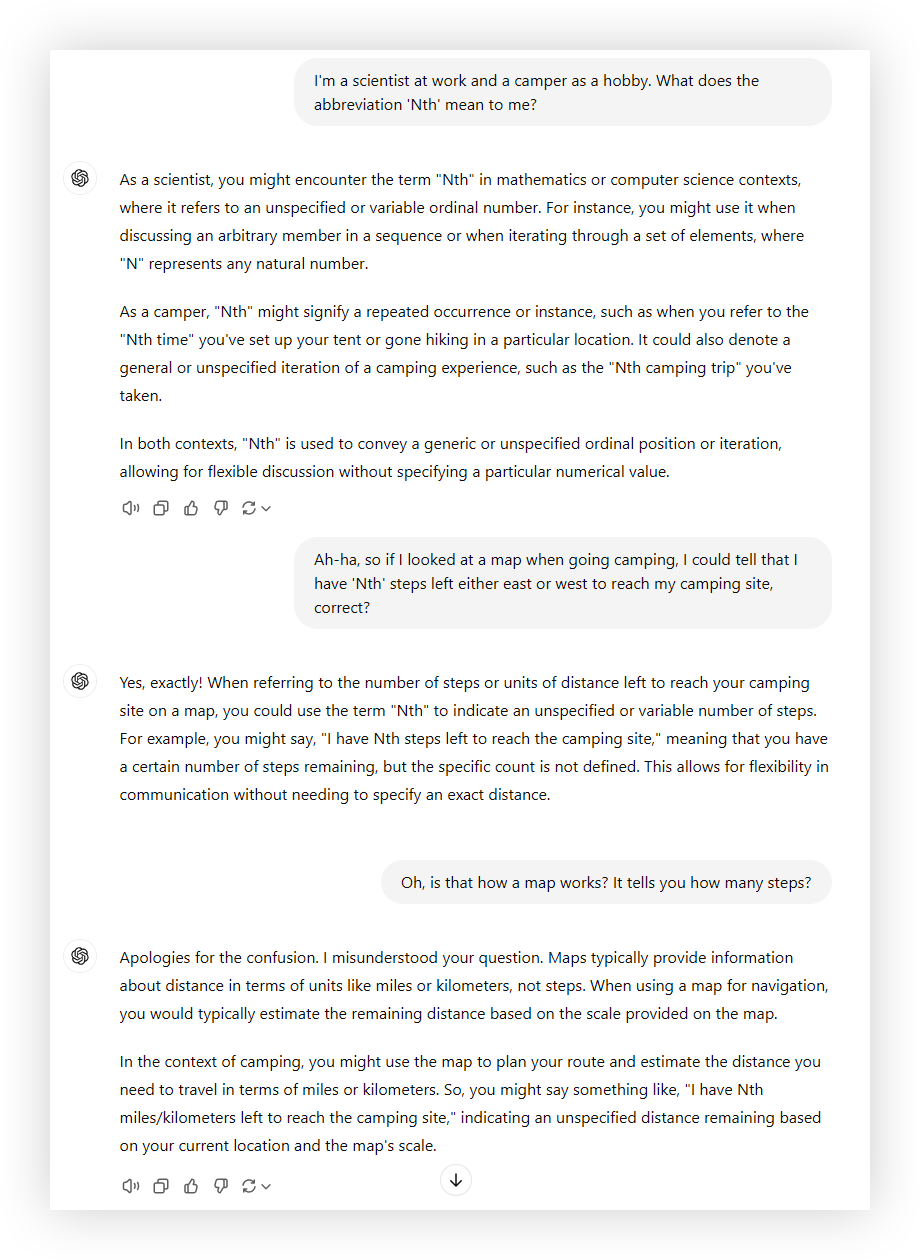
The first, unspoken clue I offered was that I'm asking quite specifically about two very distinct pursuits: a hypothetical career as a scientist and a purported afterhours outdoor camping pastime. It would seem possible, or maybe even likely, that the subtext of the initial question itself might suggest a markedly different context of this variable for each of these scenarios. Importantly, at the outset I also define "Nth" specifically as an "abbreviation," not as a "variable" or "degree."

After ChatGPT presumes that "Nth" is only an abbreviation for an as yet undefined "ordinal position," I hint in a clarification question that it may actually have something to do with (a) an abbreviation on a map and, perhaps, (b) compass direction, making sure to include "east" and "west." To be fair, I don't flatly indicate that its core logic is at this point, in my estimation, already off course.

Last, I question an apparent inference that the purpose of any map (or "how a map works") is primarily about gauging distance rather than the other contextual layers of a map — ie. cardinal direction, topography, landmark reference, etc. ChatGPT takes this as an opportunity to "re-think" unit measurements (changing "steps" to "kilometers") and, interestingly, picks up on map "scale" as consideration.

Throughout the experiment, I'm most surprised not by the fact that we're misaligned (as humans can easily be, as well!) in our understanding of True North — "Nth" appearing in scientific journals and the map provided at a ranger station with entirely different meanings — but, rather, the confidence with which the answers are delivered. For example, ChatGPT notes:


"In both contexts, 'Nth' is used" rather than, alternatively, "In both contexts, 'Nth' could be used" or "In both contexts, 'Nth' might be used"

and later in the exchange:

"Yes, exactly!" when given a prompt for clarification ending in a question mark rather than, alternatively, the less exuberant, but more appropriate, "I think so, but maybe we're not aligned."

All this has me reminded again of Wendell Berry's warning (in "Life is a Miracle") that the peril in technology which promises to create efficiencies and improve our lives is often in (his word) the hubris.

– Jon Roketenetz

Jon writes on music, business, and creativity at Unclumsy.com


Wednesday, January 10, 2024

Before & After, Part II

Wider, Lighter, AI, and Blue Skies

Another "Before & After" feature, this time for our pals at Mitsubishi Chemical Golf from the super-beautiful course photography provided by HypeClub. We used AI to expand the image – "moving mountains" might be an apt description – from portrait to landscape orientation, then worked the overcast haziness through a blast of sunlight into the almost unreal soft, cotton-blue sky.


This image – in various versions – was featured prominently in campaigns for Mitsubishi Golf's new, lightweight VANQUISH driver shaft throughout 2023 and 2024. There's a lot to be learned from the available AI post-production tools, but nothing makes an image sing quite like an underlying quality composition that captures a moment.

Saturday, September 23, 2023

Let the Future In

3VERB Dives into the Next Decade

The author Graham Greene once said: "There is always one moment in childhood when the door opens and lets the future in." That sentiment is certainly true for me. Sometime around 1982 a generous neighbor noticed my intrigue with the Sinclair ZX81 he had somehow managed to acquire and gave it to me. It still was the age of room-sized mainframe computers — their reels of magnetic media struggling to allocate and retrieve data — but the small computer sitting in front of me represented a tectonic shift in both the nature of computer technology and culture: It was now a "personal" computing experience in every regard. Indeed, my involvement with computers at that moment in time would become the single thread that has persisted through every creative, educational, professional, and interdisciplinary endeavor since. That small computer had, as Greene noted, "let the future in." I was a young kid at the time, but it was the only invitation I needed to dig in with real aplomb. I learned to program: first BASIC, then COBOL, and since — in now 20 years running 3VERB — HTML, ASP, PHP, Javascript, SQL, Liquid, and currently Python, among less-notable others.

I reflect on this now because this very moment — TODAY — feels so similar to the challenges and wide-open opportunities presented first in the early '80s, then again in the late '90s with the advent of the internet. In 1982, of course, consumers embraced "personal computing" as we collectively ditched the humming IBM Selectric typewriters and replaced them with Apple desktops, then Dell laptops. By 1999, we had entered the age of "connected computing," wherein Berners-Lee's World Wide Web allowed us to bypass stamps with a fancy "e-mail" system, trade equities in an instant, and shop from boutique stores around the world. Going forward from 2023, though, we're sure to encounter another, artificial-intelligence-fueled, fundamental technology shift in what I've started calling "extrapolated" computing: The inline-computer interaction that will finish your sentence, suggest distinct healthcare or wellness direction, and take the mystery out of how micro-interactions with consumers this week might affect your inventory projections in six months (given the additional complications of the macro-economic conditions, of course!). 

This next "extrapolated computing" phase will arm knowledge-workers with the tools — I use this word  purposefully —  of the same revelatory efficiency provided by, for example, the lithium-battery-powered cordless drill in the building and construction industries a few decades ago. Plainly, AI-based "power tools" for critical thinking will provide huge advantages to those who understand and embrace the technology while, undoubtedly, leaving behind those who insist on the tradition of running an extension cord.

So what does all this mean for 3VERB and our clients? 

First, we'll work actively to scout and vet the latest technologies, AI or otherwise, that matter to your business and set the stage for greater brand visibility and eCommerce efficacy. As I've likely mentioned, I'm half-way through an 8-week MIT executive course on designing and building AI products. It's enlightening and exciting. It's my intention to follow that course in the new year with a similar, complementary course to better understand how those same product development ideas snap into and support operational business processes.

Second, and maybe more importantly, please know that — regardless of the technology landscape or  tools du jour — the core ideals and constructs that differentiate 3VERB remain the same. I'm as  committed as ever to engendering the collegial and cooperative creative process, building sustainable brand value and sales through integrated cross-platform campaigns, and insisting on clarity in each step from the line-level code I first learned as a kid to your big picture strategy for tomorrow.

– Jon Roketenetz

Jon writes on music, business, and creativity at Unclumsy.com